 |
|
|
|
|
||
|
Colombian gold cobs
1715 & 1733 Fleet Silver
New World Portrait Gold
Pillar and Bust reales
1554 Plate Fleet
Rooswijk (
|
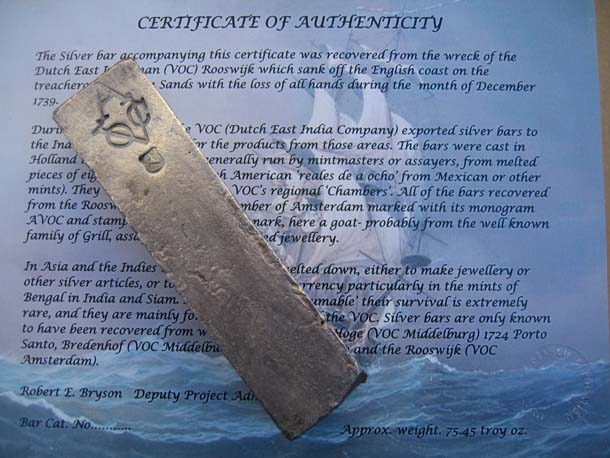
A Silver Ingot from the wreck of the Dutch East Indiaman ROOSWIJK, lost with all hands on January 9th, 1740 on the dreaded Goodwin Sands, Kent. terravitan@aol.com.
The story of the loss and rediscovery of the ROOSWIJK (pronounced Rose-vik) is well told in the monograph by Ernie Richards that will accompany this bar. I will only touch on some highlights. On January 8th, the 850 ton Rooswijk set sail from Trexel, Holland with the Dutch East India Company's Christmas Fleet. This was to be her second voyage to the Dutch Indies (Indonesia) under Capt Dan Ronzieres. Her cargo was Mexican silver coins and a group of VOC silver bars specially minted in Amsterdam (mint mark A). Silver was the principal commodity used by the Dutch in their China trade. One day out of port a North Sea gale caught the Christmas Fleet and the Rooswijk was the unlucky ship. She was driven onto the Goodwin Sands, a treacherous set of shoals off the coast of Kent, and demolished by the storm. None of her 250 crew and passengers survived. Her wrecksite could not be located by the Dutch, and nothing more was heard from the Rooswijk for 266 years.
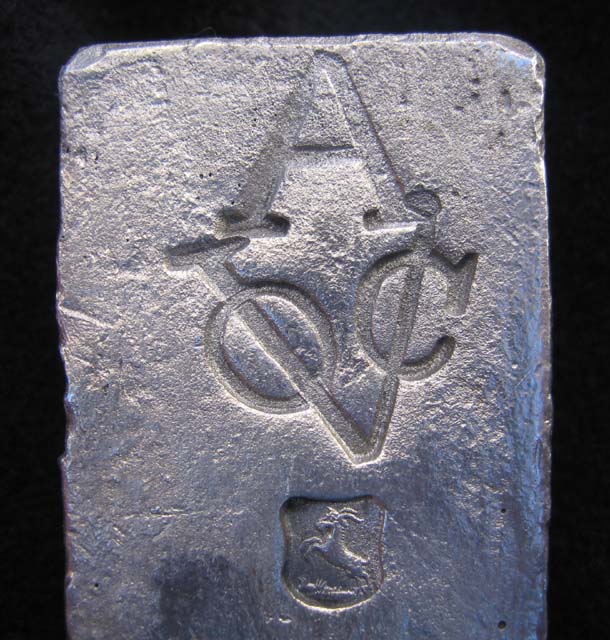
Jump ahead to 2004 and one summer day a carpenter from Cambridgeshire is exploring the Goodwin Sands. In the unusually calm waters he spies an old wooden wreck, complete with timbers and intact crates. In the crates he finds Mexican silver coins and VOC ingots! Throughout the rest of that summer and the next, Goodwin and an archaeological salvage team recover and identify the treasure of the Rooswijk. An Admiralty court rules it is the property of the Dutch government, and in December 2005 the treasure is returned to the Dutch government. The Dutch government awards a small portion of the treasure to the salvors, who auction most of their share in a March 2006 (Ponterio CICF Sale). Four VOC ingots end up being auctioned by Ponterio, with small number, including the present one, being sold privately. Most of the bars awarded to the salvors, unfortunately, show a fair amount of corrosion and salvage damage. This, I believe, is among the 2 or 3 best ingots available. This bar weighs 63.22 Troy ozs and assays at slightly above 23.5k (>98 % pure silver). In terms of markings, the Rooswijk bars are easy to decipher, but there is one mystery. At the top of the bar a large A announces the VOC Chamber (province) that issued the bar, in this case, Amsterdam. Immediately below the A we have the logo of the Dutch East Company, an interlocking set of three letters, VOC, standing for the Vereenigde OostIndische Compagnie. Next comes the unexplained item. In a small intaglio cartouche we see a rampant billygoat (geitebok) springing across a grassy plain. By Dutch law a silver ingot had to marked by the party responsible for refining it, so this must be the assayer's mark, although no Dutch assayer of the period owns up to the title of "Miijheer Willem Geitebok." Ongoing research by Dr . Arent Pol in the Netherlands may shortly disclose who "Mr Billy Goat" was.
The dimensions of the bar are approximately 6.5" x 1.5" x 1.25". SOLD, but please inquire about forthcoming examples. terravitan@aol.com or 480-595-1293
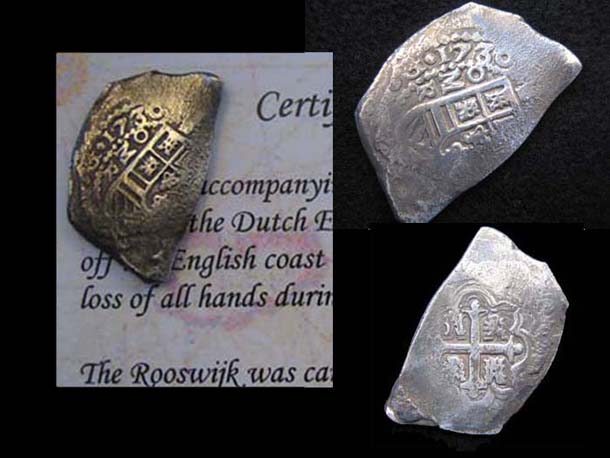
************************************************************************************************************** From the Rooswijk, a full-date 1730 R Mexican eight reales, with salvor's certificate. Nicely toned, very choice cross, date and mintmark and assayer (R) bold. Good weight at 25.18 gms. Sold.
|
|