 |
|
|
|
|
||
|
|
(All of the Lima gold cobs listed on this page are now SOLD. Our current inventory is available here. Please see the history of Lima gold cobs are the bottom of the page.)
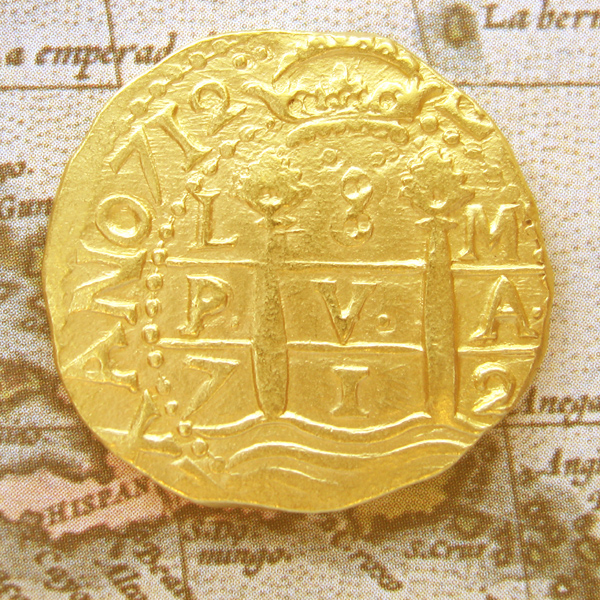
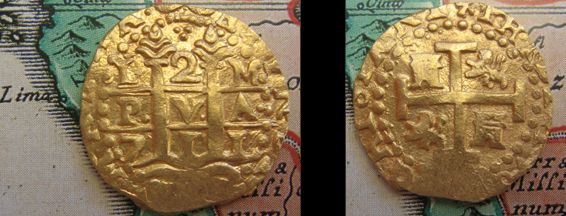
L1. Lima 1712 M eight escudos, [SOLD] a lustrous, choice mint state, and boldly DOUBLE DATED Lima onza recovered on Douglas Beach, the wrecksite of 1715 Fleet patache NIEVES.
The 1712 Lima is called a "common" date Fleet Lima, but this is a most uncommon 1712. First of all, it is a choice, perhaps even gem mint state coin, with only the lightest ocean effects visible on the cross side. Second, it has the highest relief I have ever seen on a Fleet lima. "Boldly struck" understates the medallic quality of this coin. The oh-so-desirable second date could not be bolder. Notice also the full crown. Perfect centering inevitably truncates the second date and removes most of the cross. The trade-off of off-centering for bold second date and full crown is to be wished for.
The cross side is also one of the best I have ever seen on a Fleet Lima. Here we want good centering and we have it. So often the cross or the lions & castles show some doubling, and we have to accept it, but when we see an onza with no doubling, it is a beautiful sight to behold. Full weight at just under 27 gms and on full-size 33 mm planchet. Found on the Nieves site.
SOLD.
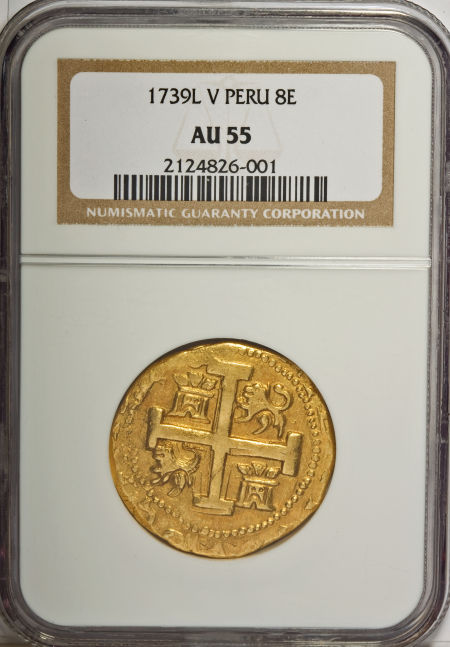
L2. Lima 1739 V eight escudos, near mint state (NGC AU-55) [SOLD]
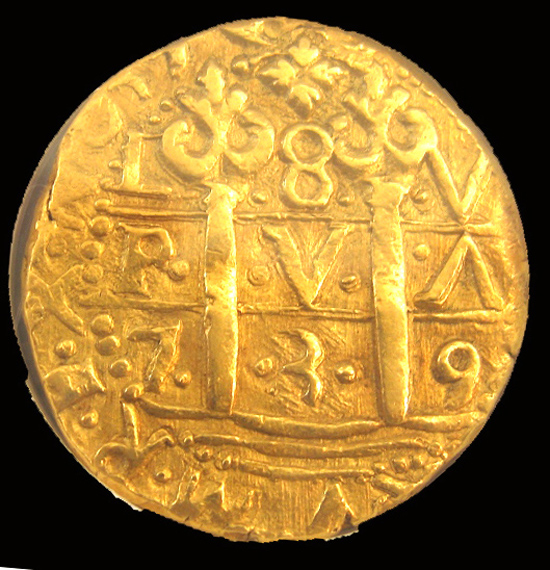
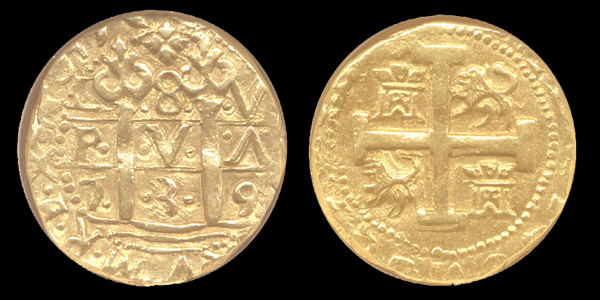
During assayer Vargas' troubled eight year tenure, the quality of gold gold issued by the Lima mint reached its nadir, but in the first year of his tenure, decent quality onzas were still being produced, as the this coin evidences. Many idiosyncrasies immediately appear on Vargas' coins. Note that a lazy die engraver has inverted the initial V above to form an A for the PVA in the central register of the onza. The legend is also unique on Lima onzas: [YNDIA]RUM .R.E.X. NO39. One seriously wonders if the die cutter was literate.
The number of mint state or near mint state onzas from the Vargas era is exceedingly small. The double date issues that advanced collectors crave are almost non-existent. This is the ONLY near mint and double date Lima onza surviving from the first year of Vargas' tenure.
SOLD. terravitan@aol.com or 480-595-1293
L3. From the 1715 Fleet, [SOLD] a 1711 M Lima two escudos in choice mint state.
Mint: Lima,
Viceroyalty of Peru origin: Douglas Beach, wrecksite of the 1715 Fleet patache NIEVES
condition: choice mint state
This Lima two escudos has everything you want in a Fleet Lima--besides a lucky 7-11 date!. Both sides are almost perfectly centered on large planchet that allows you read much of the legend. All the key letters and digits are sharp and undoubled, and the coin has gorgeous color and mint state luster. Many, if not most, 1709-1711 Lima two escudos show serious doubling and centering problem, plus poor striking in some of the central letters and digits. All show some flat spots. Clearly the Lima mint was somewhat challenged in producing a properly struck and centered two escudos. This coin is a happy exception that proves they something got it right.
A two escudos of this quality would have an opening or minimum bid of $7500 in a Spanish auction. Recent US sales have been in the $7500- $8000 for 1711's that frankly do not compare to this coin. SOLD
terravitan@aol.com or 480-595-1293
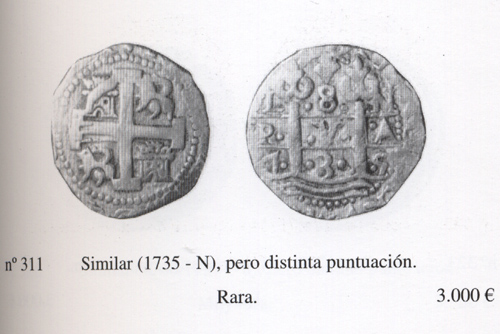
*************************************************** L4. Lima 1735 N eight escudos [SOLD] a rare & desirable issue of the Second Reign of Philip V, the Calico LA ONZA Plate specimen (#311)
Calico's LA ONZA (2004) is a masterful, and probably never to be superseded, study of all the eight escudos (onzas) issued by Spanish and Spanish Colonial mints. Calico had at his disposal thousands of photos of onzas drawn from his own 50 year old library, plus contributions from all the eminent scholars & collectors of onzas. Calico choose the best coins to illustrate dates and varieties. Collectors eagerly pursue Calico plate coins, especially the "rara" specimens, because they know these coins represent the finest known specimens.
In this case we have an exceptional, problem-free issue of assayer Joaquin Negron (N), who succeeded Melgarejo (M) in 1727 and proceeded to degrade the the quality of Lima onzas to perhaps their nadir. Badly doubled and off-center strikes become the rule by the 1740. This coin is an fortunate exception. 1735 is also a rare date that the most comprehensive Lima mint collection ever assembled, the FCC Boyd Collection, sold at the 1975 ANA, could not find a single example of. Perhaps a half dozen collector-quality specimens of this date exist. One distinctive feature of this 1735 Lima onza is a die-break arcing across the upper left castle. A cross die that began in service in 1734 was used well beyond its normal life in striking 1735 onzas. In fact, almost all 1735 Limas seem to be struck using 1734 dies--a circumstance indicating that the Lima mint was not prospering under Negron.
Sold
terravitan@aol.com or 480-595-1293
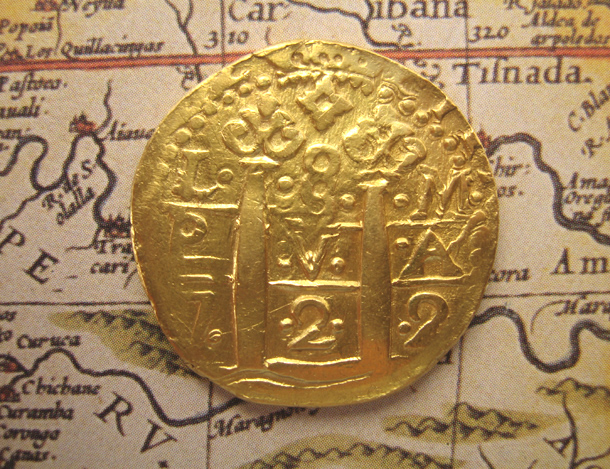
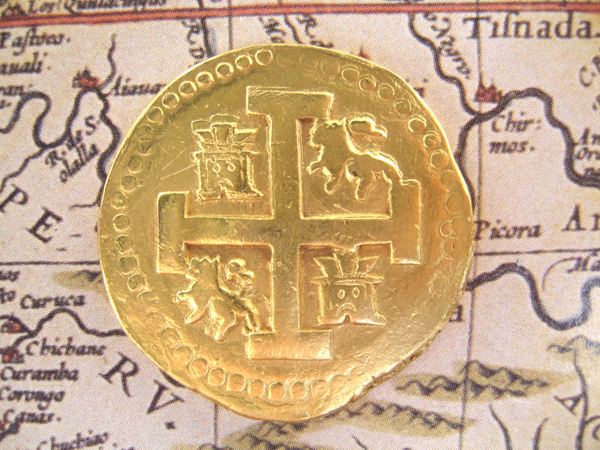
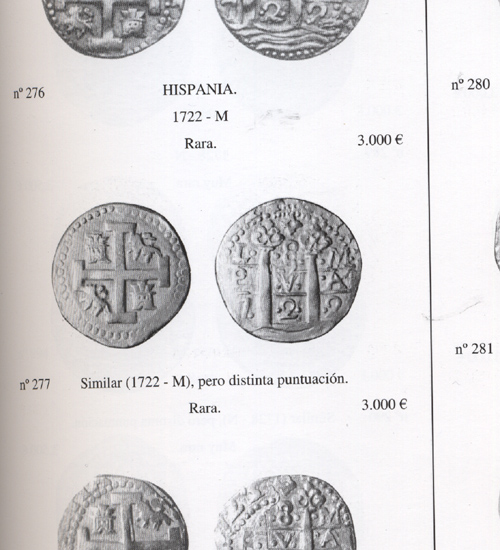
******************************************************************* L5. Lima 1722 M eight escudos [SOLD] the plate coin in Calico's LA ONZA (#277)
The 1722 has long been recognized as one of the rarest Lima onzas struck in the reign of Philip V. Yriarte and Lopez-Chavez recognized it as a key date in their 1968 Catalogo General de la Onza., valuing it 40 years ago at $850, when the price of a choice 1712 was $500 and a choice 1713 $600. Only TWO 1722 Limas with complete 722 dates are known to me, and both have found their way into Calico's definitive study LA ONZA (2004). This is onza #277, pictured on page 104 in LA ONZA and reproduced below. Both this onza and and the second 1722 pictured in Calico were reported to be river finds from Peru in the 1930's. After conservation the second 1722 unfortunately showed considerable surface problems from 200+ years in river mud. Happily, this specimen was spared any corrosion or damage. Well struck, nice golden color, considerable original luster, but a little bright from conservation.
It may be a bit misleading to call a coin "the finest known" when the surviving population is miniscule, but in this case Calico's photos make the comparison easy. Collectors of Lima 8 escudos prize key dates like the 1722 and are especially fond of Calico Plate coins. This coin does not have the magnificent preservation and surfaces of the best 1715 Fleet pieces, but at half the price of a Fleet onza, it is an affordable, pedigreed rarity and the finest you can hope to obtain for this rare date.
SOLD. terravitan@aol.com or 480-595-1293
*********************************************** ********
A Brief History of Lima Gold Cobs
After a short-lived, unauthorized experiment in gold coinage in 1659-60-- which enraged Philip IV-- the Lima mint began legally striking gold cobs in 1696. It continued to do almost continuously until 1750. Earthquakes, plagues, mining and economic problems several times curtailed gold production at Lima, but only in one year,1706, does a combination of these conditions seem to have stopped it.
Gold cobs were struck each year in four denominations: an eight escudos or onza of about 27 grams, and a four, two and one escudos at appropriate fractional weights. Onzas always comprised the bulk of the mintage, followed by the two and the one escudos. The design of the onza was repeated at reduced scale on the four and two escudos. The one escudos featured a single castle and small cross design.
Lima gold cobs were struck in the name of these four Spanish monarchs: v Charles II, 1696-1701 ( Charles died in 1700 but his coinage continues into 1701 ) v Philip V, 1701-1724, 1724-46 ( second reign) v Luis I ( 1724) v Ferdinand VI (1746-1750)
Six assayer’s initial appear on Lima gold cobs: Ø H—Francisco Hurtado, 1696-1711 Ø R— Miguel Rojas , 1699 Ø M – Cristobal Melgarejo, 1709-1728 Ø N—Joaquin Negron, 1728-1741 Ø V— Vargas, 1739-1748 Ø R-- Jose Rodriquez 1748-50
In general the quality of gold cobs produced under Capt Hurtado was high, very high in the first years of the coinage under Charles II. Melgarejo at first continued to strike high quality gold cobs, but by the end of the Fleet era (1714), flans were becoming smaller and designs ( especially the cross) cruder. Some design experimentation in 1716-1717 produced the modified types that would henceforth grace Lima gold cobs. By the end of Melgarejo’s tenure and throughout those of his two immediate successors, Negron and Vargas, quality continued to decline, reaching its in nadir in some 1740’s issues of Vargas that are almost unrecognizable as Lima gold cobs. Some improvement occurred in the last three years of cob coinage at Lima under Rodriquez, but on small, crowded flans, so unlike Hurtado’s wonderful issues.
Two shipwrecks have contributed significantly to our knowledge and the collectiblity of Lima gold cobs. Prior to the discovery of the 1715 Fleet Florida wrecks in the 1960’s, many of the gold cobs in the era 1696-1714 were completely unknown or known in only one or two specimens. 1715 Fleet salvages have added perhaps 1500 collectible specimens to that population. Many Fleet dates remain very rare coins (1-3 known), but now at least there is a chance to own a 1702 onza or 1700 media onza! About 150 beautiful Lima gold cobs are impounded in the Florida State Collection.
A shipwreck found in 1992 in Montevideo harbor has also done a great deal for the collectibility of the final years of Lima gold cobs. The wreck of Nuestra Senora de la Luz has yielded over a hundred Lima onzas and media onzas dated 1749-50, with occasional dates back to 1744. 1750 media onzas were not known to exist prior to this find.
Smaller more recent finds include a scant but interesting group of 1715-17 Limas from the 1719 wreck of the VOC merchantman Loosdrecht off the Isle of Wight. Surprisingly, the 1733 Fleet sites of the Florida Keys have not yielded any verified finds of Lima gold.
©2007 Goldcobs.com All Rights Reserved. |