 |
|
|
|
|
||
|
Philip IV (1621-1665)
Charles II (1665-1700)
Philip V (1700-1746)
|
COLOMBIAN GOLD COBS (1622-1756) (A brief history of Colombian gold cobs follows C7.) (Please note: All the Colombian gold cobs on this page are now sold.)
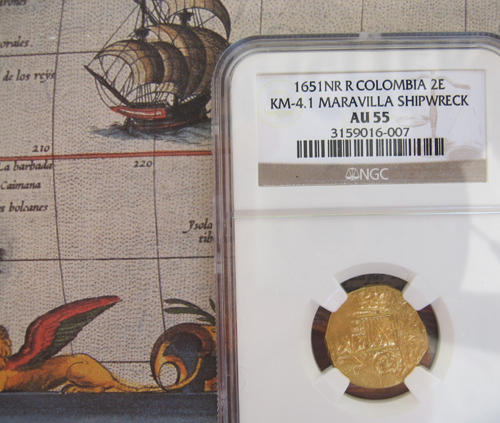
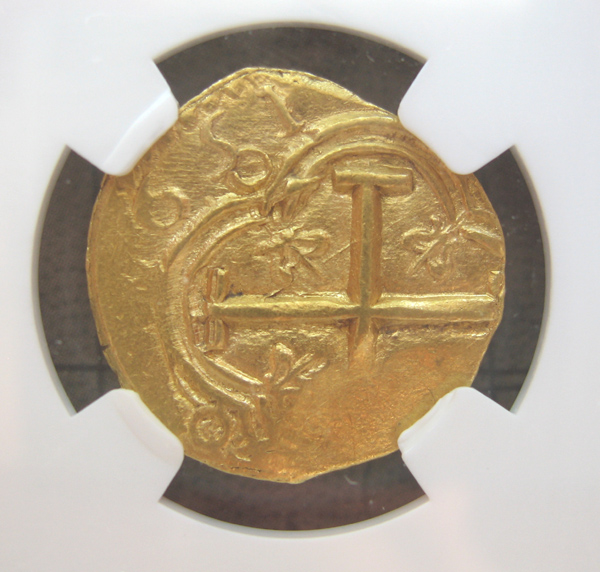
C1. From the 1656 Bahamian Shipwreck of the Spanish Galleon NUESTRA SENORA DE LAS MARAVILLAS, a Santa Fe de Bogota two escudos, a choice and very rare full-date 1651 issue. Just three 1651 Bogotas are known, two of them recovered from the Maravillas. [SOLD]
The Nuestra Senora de las Maravillas was the unlucky Almiranta of the 1655-56 Treasure Fleet. The galleon and 600 of those on board perished in a storm off Grand Bahama Island on the night of January 4, 1656. Her cargo included coins and precious metal bars recently salvaged from the 1654 Ecuadorian wreck of the Capitana. This treasure was apparently not destined to reach the financially strapped Felipe IV. The Spanish did manage to salvage a little of the treasure in 1657, but could not find the site in subsequent years. It was not until 315 years later, in 1972, that Bob Marx finally rediscovered the legendary wrecksite and began to salvage coins and artifacts . In 1973 a fifteen year hiatus began, enforced by the Bahamian government, until salvage resumed in 1988 under the Marex Corporation, led by Capt. Herbert Humphrey. Marex successfully worked the site for artifacts, emeralds, silver coins, and a group of about 400 Bogota two escudos, including the present coin.
I recall in the early 90's when some choice groups of the Marex coins were being made available. Joe Lasser bought a group for his collection and these were eventually sold in Ponterio's January 2005 auction. Lot 832 of that sale is a Marex Bogota (16)51, though not so identified in the catalogue. I invite you to compare that coin with the present specimen. In February 2005 the Goldbergs auctioned the a choice group of 160 Maravillas Bogotas retained by a principal of the company. There were NO 1651's in that collection. 95% of the Bogota two escudos recovered from the Maravillas are 1654 or 1655 issues. TWO of the 3 known 1651's are documented as Maravillas coins. Only one other 1651 Bogota exists, a coin that first surfaced at auction in May 1966 (Kreisberg-Schulman, lot 2473; later Lasser M50S-25).
******************************************************************************************************
C2. From the 1715 Fleet. Reign of Charles II (1665-1700) Santa Fe de Bogota. Two escudos. 1699. [SOLD]
**************************************************************************************
C3. From the 1715 Fleet Santa Fe de Bogota, two escudos, a boldly dated 1705. An absolutely mint state specimen from a group found in the 1960's by Real 8 on Douglas Beach, the wrecksite of the 1715 Fleet patache NIEVES.
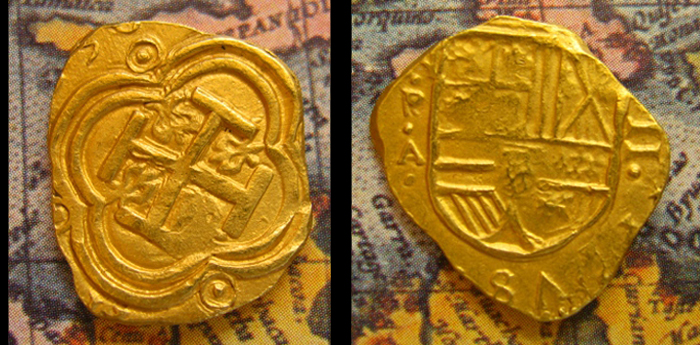
This a beautifu mint state 1705 Bogie with a bold 705 date and a well-struck shield & cross. Notice the letter A to the right of the shield. This is from the legend CAROLUS. Almost all Bogies from 1700 to 1714 were struck in the name of Carlos II, the Hapsburg monarch who died in 1700. The authorities at Bogota were apparently unwilling to anticipate a victory by the new Bourbon king Philip V in the war over succession to the Spanish throne.
For some reason 1705 is a heavily faceted issue with flat areas that often obscure most of the shield and cross. This is example is far better than average. Most of the cross and shield are boldly struck on this coin. The coin is as lustrous as when it was struck 304 years ago! No one has ever ventured an explanation of why the NIEVES should contain a small hoard of mint state 1705 Bogies among its treasures, but it did. Perhaps a Colombian merchant was returning to Spain with his savings. The manifest and passenger list for the NIEVES has not yet surfaced. Weight: 6.75 gms. Diameter: 21.5 mm.
C4. From the 1715 Fleet [SOLD] Santa Fe de Bogota, two escudo, 1707 A very rare date, just three collectible specimens known and this by far the best of the three. A well struck, near mint state rarity that shows the grey & white coral deposits definitive of Corrigan's Beach, the wrecksite of the capitana of the 1715 Fleet, NUESTRA SENORA DE LA REGLA..
For some reason the 1707 is a substantially rarer Fleet date than many of issues like 1705 that precede it it. The few 1707's recovered from the Fleet, moreover, were clearly from a merchant's private purse, and not a shipment from the Bogota mint. All 1707's show slight signs of actual circulation.
This enlargement allows us to discuss some interesting features of the cross side die. All of the 1707 I have seen before, including the Florida State coins, show only a truncated date with most of the 7's chopped. So the Ubilla (1964) and Schulman (1972) and Lasser (2005)specimens. This is the only 1707 known to me showing a clear 707. Notice the first and second second are very different in style! ThAT kind of thing happened at Bogota!
The shield side is well struck (for a Bogie!) but shows a central transverse die crack that affects almost all 1707. This crack got worst in later striking, erasing most of the shield detail. Almost all of the posthumous monarch's name, CAROLUS, is visible in the legend. This is very rare. Abundant grey matrix and coral, a signature of Corrigan's Beach coins, remains on both sides of the coin. Corrigan's is known to be the wrecksite of the 1715 Fleet capitana NUESTRA SENORA DE LA REGLA. Weight: 6.80 gms Diameter: 22 mm.
C5. Santa Fe de Bogota, two escudos (1729), [SOLD] Second Reign of Philip V (1700-1746). Beautifully struck, mint state, very rare late style issue of assayer Sanchez de la Torre (S) Restropo type M80-8. PCGS calls it an AU-58! !
My photo cannot do justice to this Sanchez two escudos since it sits in a PCGS slab. It is a lustrous, golden, absolutely mint state coin. You can see the quality of the quality on both sides. Look in Lasser's and Restropo's books, and you will get some idea how rare this kind of definition is on Second Reign Bogota. I have never seen a better struck, higher grade Bogota two.
Only one dated 1729 is known and it die-matches this coin. I know of only one other (1729) two escudos, far inferior to this coin. At the end of his eleven year tenure (1722-1732) Sanchez developed a simple but distinctive style that I call the "triumphal arch" style. Look at the shape of the castles in the shield of Castile & Leon. Only on Sanchez issue of 1729-1731. This simplified--some would say crude--rendering of the Bourbon arms that assayer Arce introduced reaches its highest expression in these final issues of Sanchez.
This Bogota two escudos has a diameter of 20.5 mm and displays full mint luster and no wear. The "experts" at PCGS have graded it AU-58.
Available for $2250 terravitan@aol or 480-595-1293
C6. From the famous 1636 MESUNO Shipwreck Santa Fe de Bogota, two escudos (1636). [SOLD]
El Mesuno is a treacherous bend in the Magdelena River about 67 miles downriver from Bogota. In late 1636 a dispatch boat carrying a fresh shipment of two escudos from the Bogota mint came to grief on one of El Mesuno's shoals. The entire shipment of about 1400 gold pieces disappeared into river and could not be recovered. Exactly three hundred years later, in August of 1936, a group of workmen dredging the river stumbled upon a remarkable hoard of gold coins and artifacts, which became known as the Mesuno Hoard.
The Colombian Banco de la Republica acquired the hoard and by the mid-50's began to disperse some of it through several well-established numismatic firms. In America Stack's (Coin Galleries) was the outlet, and for nearly 20 years sold several hundred Mesuno coins. Pictured below is a copy of their very rare inaugural 1959 sale of Mesuno coins, featuring articles on the Mesuno wreck & coins by C.S.Wilcox and others. The present coin almost certainly came from one of those early Stack's sale.
This coin is a far above average Mesuno two escudos, with a almost complete and well struck shield and cross. The coin in mint state with no sign of circulation or mishandling. Many Mesunos were overcleaned or immediately put into jewelry. Original as-they came out-of -the-Magdalena Mesunos are very hard to find these days. This coin is is undated, but it die-matches perfectly with the few Mesuno coins that do bear a 1636 date. The coin weighs 6.64 gms, its diameter is 21 mm, and the reference number in the Lasser and the Restropo texts is M50S-15.
[SOLD]
************************************************************************
C7. A choice mint state (NGC MS-62) 1636 Bogota from the famous 1636 Mesuno wreck. Santa Fe de Bogota, two escudos (16)36. a lustrous mint state coin, 6.7 gms, 22 mm [SOLD]
Several new NGC certified Mesunos are now on new Mesuno page here
terravitan@aol.com or call 480-595-1293
CColombian Gold Cobs (1622-1756)
What would later become the Viceroyalty of New Granada acquired one of its first casa de fundicion (assay office) at Marquita in Central Colombia about 1590. Marquita issued officially stamped gold ingots for 30 years, some perhaps imitating the Tejeulos system being used at Mexico City. None of these ingots apparently survive, a circumstance that a new Tierra Firme shipwreck, 1590-1625, may eventually remedy.
In 1620 Philip III sold Capt Alonso Turillo that right to establish a mint at Bogota with an oficina or branch mint at Cartagena. Turillo arrived in Colombia in 1621 and very quickly commenced a silver coinage. About a dozen or so two escudos dated 1622 give evidence that a brief gold coinage may also been attempted in Cartagena. No doubt some of this 1622 issue was struck in Madrid as patterns to show Philip III and his court, but the dies may have later accompanied Turillo to Cartagena and been used again. A final judgment on the 1622 gold coinage is not yet possible.
Mint records show that Cartagena began to strike two and one escudos in 1627 and continued to do so for 9 years (1627-1635). No gold coins attest a brief possible minatge in 1626. Under political pressure from officials at Bogota, Cartagena was never allowed to strike gold after 1635. The Bogota mint began regular production at the same time as Cartagena, and with a few brief hiatuses struck gold cobs until 1756.
For 110 years Bogota struck only one and two escudos. Very few one escudo survive--the first is dated 1685--suggesting that the original mintages were small & episodic. Bogota one escudos showing a legible date are extremely rare before assayer Molano (1730's). Late in the 1730's, faced with large new gold deposits to refine and coin, Molano began to strike four and eight escudos. Four and eight escudos were struck for 20 years, until the switch to milled coinage in 1756.
Our knowledge of
Colombian gold (and silver) cobs is heavily indebted to four
shipwrecks. The Mesuno wreck of 1636 and the Maravillas shipwreck of
1656 added greatly to our knowledge of Philip IV era Colombian gold.
The 1715 Fleet Florida wrecks did the same for late Carlos II and
early Philip V issues, and of course the 1622 wreck of the Atocha has been
a key player in sorting out the first gold & silver issues of
1621-22.
©2007 Goldcobs.com All Rights Reserved.
|