|
SPAIN
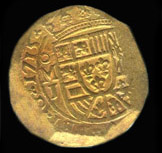
S1. 1597 Seville 2 escudos, full date on a large planchet.
From the matrix &
coral, a Bahamian shipwreck lying close to the Maravillas,
very possibly a Maravillas coin.

Mint: Seville, Spain
Denomination: two escudos
Date: 1597 reign of Philip II ( 1556- 1598 )
Assayer: B
Weight: 6.74 gms
diameter: 22 mm
Obverse: Crowned Hapsburg shield with the date (1597) boldly visible
to the right. Border of dots around.
Reverse: Cross potent surrounded by quatrefoil. Fleurs-de-lis in the
angles of the cross. Four circlets surround the quatrefoil. Border
of dots.

The so-called New Coinage (Nueva Estampa) of Philip
II was undated for its first 20 years. Then, beginning in 1588 at
Seville, dated two and four escudos appeared and were issued for the
final ten years of Philip’s reign. At the end of the dated series,
assayer B struck some of the finest quality gold cobs to come from a
Spanish mint in the 16th century. This coin falls toward the end of
that final series. Calico & Trigo 71, Cayon 4131 , Fr-169.
All full date 16th century Spanish coinage is rare and highly sought
after. It is still underpriced in the marketplace.
Preservation: Marine deposits (silts)
including corals on both obverse and reverse
testify to its shipwreck origins and locate it on the Bahamian
shoals. Several older Spanish two escudos were found on the
Maravillas (1656) and, despite obvious differences, were sold in
the 1970's as Bogota coins. A well struck and
problem free coin on a large (22 mm) planchet.
-
Now available. $2850.
Santiago de Chile. 1751 J.
Eight escudos of Ferdinand VI. [SOLD]
Choice Mint State, lustrous,
very well struck. M/7 dies.

A choice Santiago onza
from the LUZ is a very hard coin to find. First of all, quality
control at Santiago in 1751 was conspicuously poor. The vast
majority of 1751 onzas are poorly struck on one or both sides,
creating an ugly flattening portrait of Ferdinand VI and an
illegible shield. Many 1751 onzas also show heavy die-breaks,
off-center strikes, and irregular planchets flattened at 6 o'clock.
Add to these production problems the effects of marine deposit and
heavy ocean corrosion. The result is that perhaps 5% of the LUZ's
Santiago treasures are in the choice condition we see on this coin.
The strike is exceptional, giving an almost medallic relief to the
coin. The coin is lustrous with the fields show considerable
prooflikeness with just a trace of sea effect. The planchet is round
and problem-free.
Sold.
Coming soon

Price on request.
©2007 Goldcobs.com All
Rights Reserved.
|