 |
|
|
|
|
||
|
Philip IV (1621-1665)
Philip V (1700-1746)
|
COLOMBIAN GOLD COBS
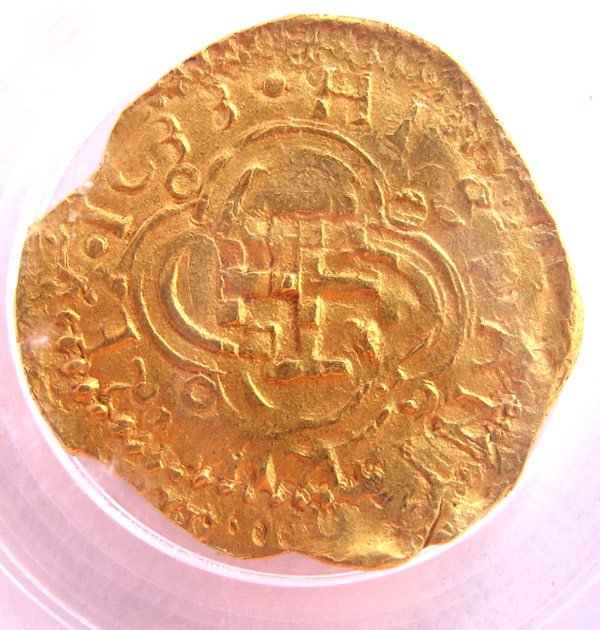
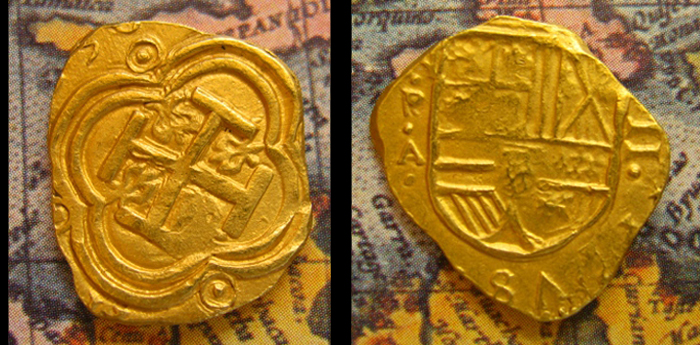
SF11. Santa Fe de Bogota, 1633 NRA two escudos. Very rare, the only fully dated 1633 and a unique example of an experimental redesign of the two escudos as a four escudos size (26 mm) coin. Restropo Plate coin M50-11. Struck on a huge 26 mm planchet but at normal weight 6.7 gm. ex Lasser Collection. PCGS AU 58. [sold]
At first sight this is one of the most puzzling issues of assayer Anuncibay's (A) long tenure (1627- 41) at Bogotá. It does not resemble stylistically anything that comes before it or after it. It is not an accidentally oversized striking, but a deliberate experiment with a larger, thinner planchet such as were favored on some Spanish peninsular issues. A special 16 mm shield punch was prepared (13 mm is the normal depth of a Bogotá shield of this period). A novel cross design was used with short thick bars and crossbars. A more compact tressure allowed more space for legends, which were never visible on Bogotá escudos of this period. No doubt that was the intent of this redesign: to make the legends PHILIPPUS IIII D.G. HISPANIARUM REX 1633 legible. Well, you can see for yourself the results of this experiment. Unless large, thin planchets are very well prepared with uniform thickness, you will get the problems you see here. The planchet becomes irregular as the gold spreads unevenly and flat spots appear especially along the edge were too little gold is present. The Bogotá mint in this period had nowhere near the technical skills to prepare a uniform planchet that would strike to a round 26 mm diameter.
Somewhere in the Archives of the Indies there is no doubt a letter to the Governor-President of the Audiencia of Bogotá saying that Philip IV would like to be able to read his name on the gold coins of Bogotá. The Governor promptly instructed Anuncibay to try to do this. Anuncibay tried and here is the result. Bogotá simply could not strike acceptable quality 26 mm two escudos. A few of these trials were probably sent to Philip IV with a very polite "sorry, but no can do" letter. Bogota returned forever more to striking its familiar no-legend 19-20 mm two escudos. Only one other (but undated) example of this experimental issue is reported to exist.
(A Spanish version of this entry with additional photos is available here)
Sold.
terravitan@aol.com or 480-595-1293
******************************************************************************
SF33. From the 1715 Fleet
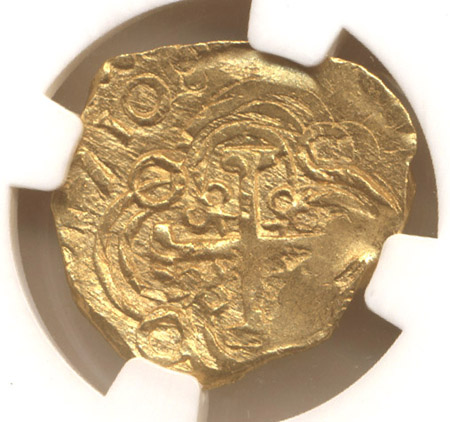
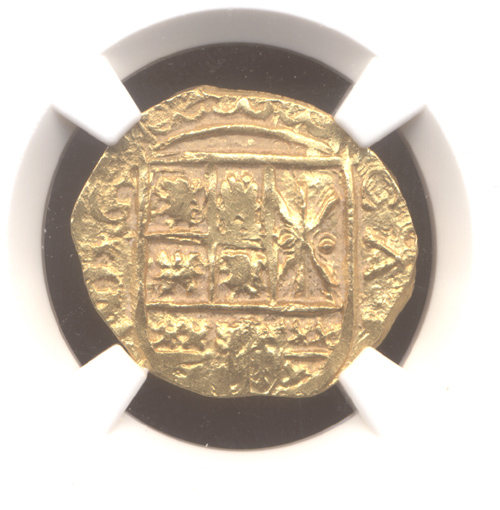
Santa Fe de Bogota, two escudos, a very rare boldly dated 1710. NGC MS 62 1715 PLATE FLEET. The finest and the only mint state 1710 known. From a group found in the 1960's by Real 8 on Douglas Beach, the wrecksite of the 1715 Fleet patache NIEVES. SOLD
Only three dated and several undated 1710's have surfaced from the 1715 Fleet. Before the Fleet salvages of the 1960's it was not even clear that Santa Fe de Bogota had struck escudos in 1710. This lustrous mint state 1710 Bogie has a much bolder date than Joe Lasser's 1710, which shows only the bottom third of the 1710 and is an XF grade coin. Restropo in his Moneda de Colombia, 2nd Ed (p. 97) illustrates the third known dated 1710. Not a bad coin, but AU in grade and the date is little truncated.
From 1701 to 1714 Bogota two escudos were struck in the name of Carlos II, the Hapsburg monarch who died in 1700. The authorities at Bogota were apparently unwilling to anticipate a victory by the new Bourbon king Philip V in the war of succession to the Spanish throne. All dated Bogies from this era are rare to very rare. Even Joe Lasser with his financial resources could not complete a dated Fleet-era set.
terravitan@aol.com or 480-595-1293
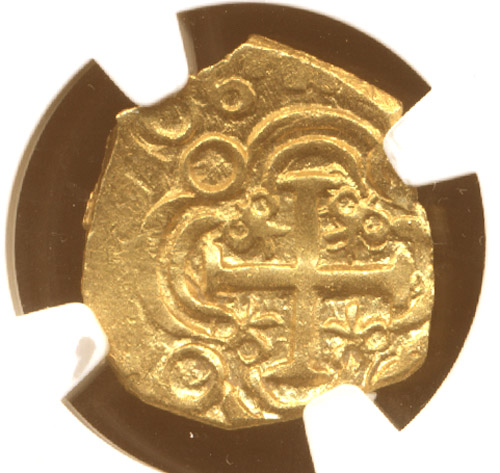
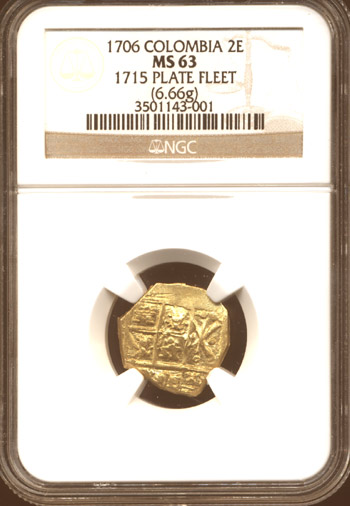
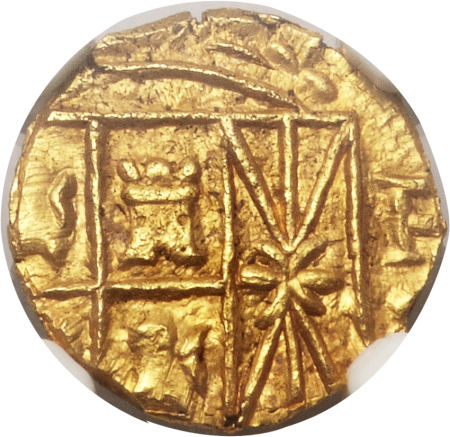
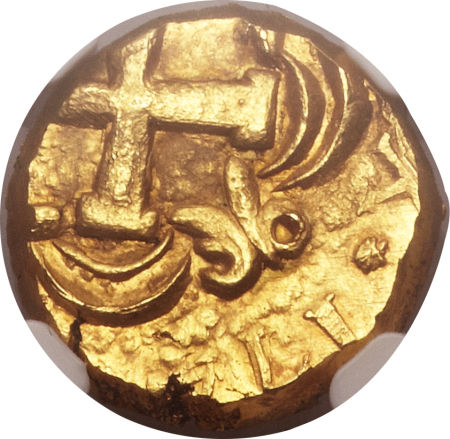
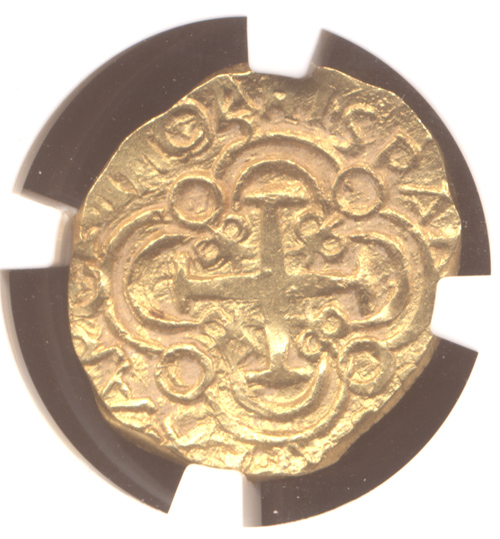
SF44. From the 1715 Fleet Santa Fe de Bogota, two escudo, 1706. Reign of Philip V. Lustrous, mint state, and very boldly struck. NGC MS 63 1715 PLATE FLEET. Found by Real 8 in July of 1964 on the Nieves site SOLD
This rare date, unknown before the Fleet, is represented by only four dated collectible specimens, all found together in a small group 48 years ago this summer on the Nieves site. At the 1964 Division the State of Florida claimed half of the group, leaving Real 8 with four 1706's. Real 8 auctioned two of the coins (1967,1972) and kept (the best) two in their personal collections. This coin remained in the personal collection of an original Real 8 member for more than 40 years. Besides being the finest known 1706, this is one of the finest Bogota two escudos from the entire Fleet era. NGC and PCGS have graded no Fleet two escudos higher than MS 63.
terravitan@aol.com or 480-595-1293
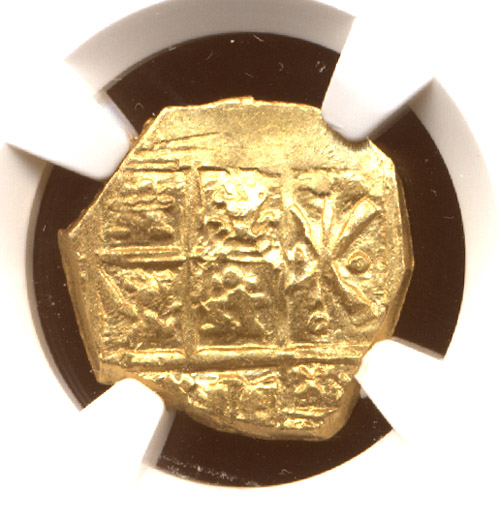
SF49. Santa Fe de Bogota, 1 escudo, 1749. Choice mint state. Reign of Ferdinand VII. Very rare, the entire mintage (1747-56) of cob one escudo under Ferdinand VII is represented by three surviving coins, the other two being worn VF's. Struck from two escudos dies (no one escudo dies were probably produced). This is in fact the only known mint state one escudo known to have survived from the entire Bogota cob series 1622-1756! !
One escudos were never a regular feature of Colombian cob coinage and increasingly disfavored by the later part of Philip V's reign. One escudos were struck on demand by people who deposited gold at the mint, and very few of these wanted one escudos. Ordinary commerce was in silver. If you were in the business of exported gold for European goods, would you want eight small one escudos or one 8 escudos? Apparently a small issue of one escudos occurred in 1754, but before then no issues were known after 1742--until this coin surfaced from Spain. It is something approaching a miracle for a 1749 Ferdinand VII one escudo to have survived 262 years!
Sebastian de Rivera was the Bogota assayer under Ferdinand VII. The style of his issues was been studied and even without a date we would know this was a 1749-1751 issue. Fortunately, the clear 174 and much of the 9 save us from guessing within that interval. Notice the highly stylized fleur de lis facing the angle of the cross. Joe Lasser and Jorge Restropo, without the benefit of this coin and using higher denomination reales and escudos, thought this design was a Rivera issue of 1750-51, but now we now Rivera's die cutter was first active in 1749. If you are interested in cob one escudos from the long-lived mint at Bogota, this is the best example you will ever see.
Available. Price on request.
terravitan@aol or 480-595-1293
From the 1715 Fleet
SF66. Santa Fe de Bogota, 1704/3, two escudos. Unique. Well centered, well struck on a large round planchet, lustrous choice mint state with generous amounts of delicate pink coral. Posthumous assayer-less "Carolus" issue of 1701-1713 with clear CA to the right of the shield. One of the most attractive Fleet Bogies I've seen. SOLD
From Real 8 's first and famous Ubilla-Echevez Sale of October 8, 1964, lot 174, and by far the best Fleet Bogie in that sale.
The collectible population of 1704 Bogies stands at five, but there is one and only one 1704/3 overdate. All 1704 Bogies--none were known before 1964--were sold by Real 8 in the 1960's, four by auction. Since the early sales a 1704 has become very difficult to find. Joe Lasser could not locate one for his monumental collection. The current reference book on the series, Restrepo's MONEDA DE COLOMBIA, has the date as unlisted/unknown. The 1704/3 overdate is typical of the "artistic" (some would say careless) way die sinkers treated the legends at Bogota. The original 1703 date had an overlarge 0 with a long 3 wedged low against it. When it was time to add the overdate, the die cutters did not try to erase the 3 but simply added the 4 over it, high and far enough to the right that the bottom of the 4 now touches the base of the H in HISPANIA.
I was very surprised to see this classic Bogie arrive in an NGC holder. NGC usually will not grade substantially coraled Fleet pieces (fearing that the coral has been added to cover mischief) and suggests the coin go to NCS for "conservation" (cleaning) before grading. Fortunately, the owner declined "conservation" and NGC finally agreed, when the Ubilla Sale pedigree was pointed out to them, to call it a MS 60 1717 Fleet. In actuality it is lustrous choice mint state coin with beautiful color and surfaces on a big round planchet. If I were to assign a numerical grade to the coin, it would be at least MS 64.
terravitan@aol.com or call 480-595-1293
************************************************************************
SF7. A choice mint state 1636 Bogota from the famous 1636 Mesuno Shipwreck Santa Fe de Bogota, two escudos (16)36.
A lustrous mint state , 6.7 gms, 22 mm.
More Mesuno coins are now listed on the new Mesuno page.
terravitan@aol.com or call 480-595-1293
CColombian Gold Cobs (1622-1756)
What would later become the Viceroyalty of New Granada acquired one of its first casa de fundicion (assay office) at Marquita in Central Colombia about 1590. Marquita issued officially stamped gold ingots for 30 years, some perhaps imitating the Tejeulos system being used at Mexico City. None of these ingots apparently survive, a circumstance that a new Tierra Firme shipwreck, 1590-1625, may eventually remedy.
In 1620 Philip III sold Capt Alonso Turillo that right to establish a mint at Bogota with an oficina or branch mint at Cartagena. Turillo arrived in Colombia in 1621 and very quickly commenced a silver coinage. About a dozen or so two escudos dated 1622 give evidence that a brief gold coinage may also been attempted in Cartagena. No doubt some of this 1622 issue was struck in Madrid as patterns to show Philip III and his court, but the dies may have later accompanied Turillo to Cartagena and been used again. A final judgment on the 1622 gold coinage is not yet possible.
Mint records show that Cartagena began to strike two and one escudos in 1627 and continued to do so for 9 years (1627-1635). No gold coins attest a brief possible minatge in 1626. Under political pressure from officials at Bogota, Cartagena was never allowed to strike gold after 1635. The Bogota mint began regular production at the same time as Cartagena, and with a few brief hiatuses struck gold cobs until 1756.
For 110 years Bogota struck only one and two escudos. Very few one escudo survive--the first is dated 1685--suggesting that the original mintages were small & episodic. Bogota one escudos showing a legible date are extremely rare before assayer Molano (1730's). Late in the 1730's, faced with large new gold deposits to refine and coin, Molano began to strike four and eight escudos. Four and eight escudos were struck for 20 years, until the switch to milled coinage in 1756.
Our knowledge of
Colombian gold (and silver) cobs is heavily indebted to four
shipwrecks. The Mesuno wreck of 1636 and the Maravillas shipwreck of
1656 added greatly to our knowledge of Philip IV era Colombian gold.
The 1715 Fleet Florida wrecks did the same for late Carlos II and
early Philip V issues, and of course the 1622 wreck of the Atocha has been
a key player in sorting out the first gold & silver issues of
1621-22.
©2007 Goldcobs.com All Rights Reserved.
|