 |
|
|
|
|
||
|
Charles II (1667-1700)
|
From the 1715 Fleet
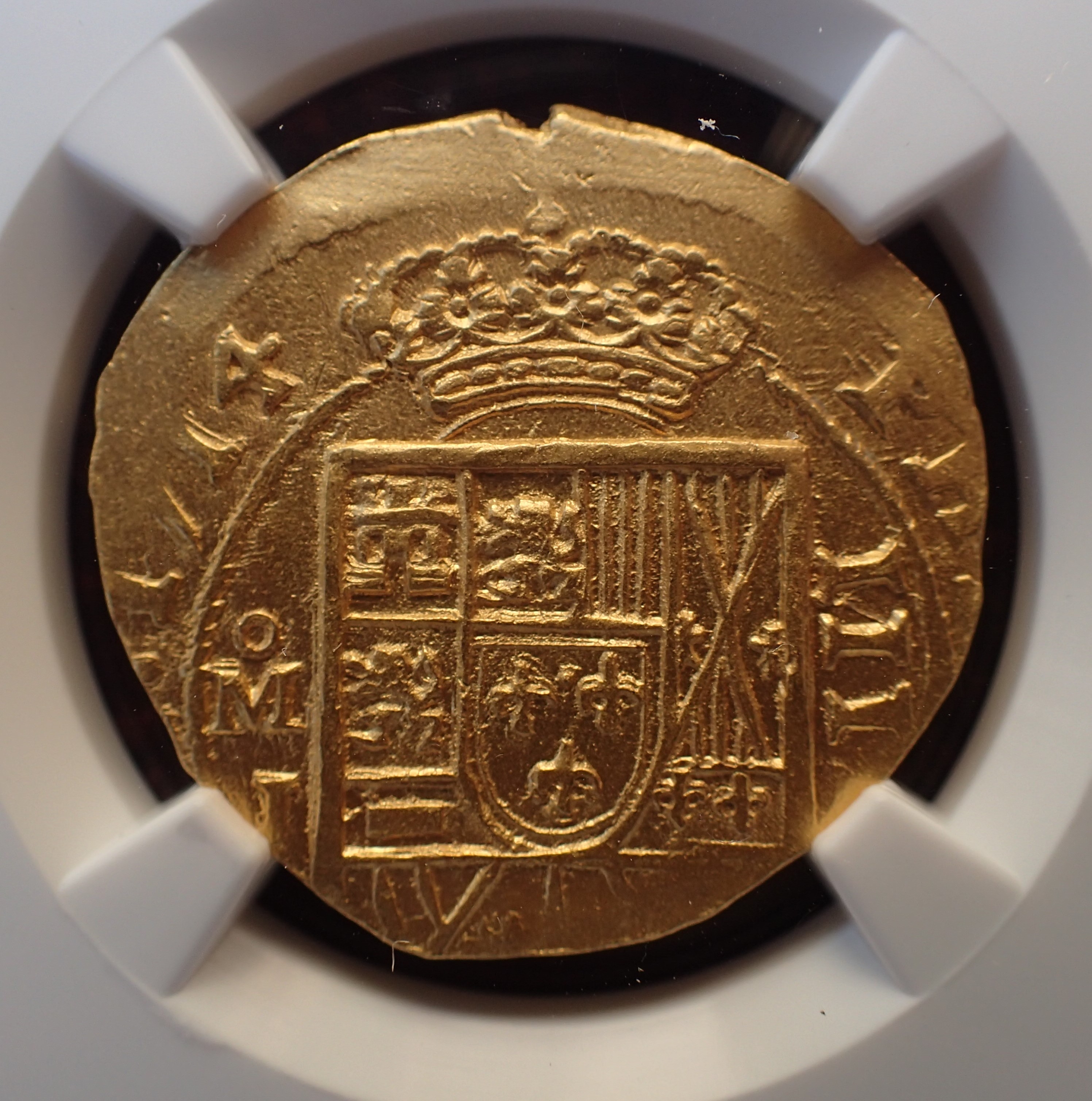
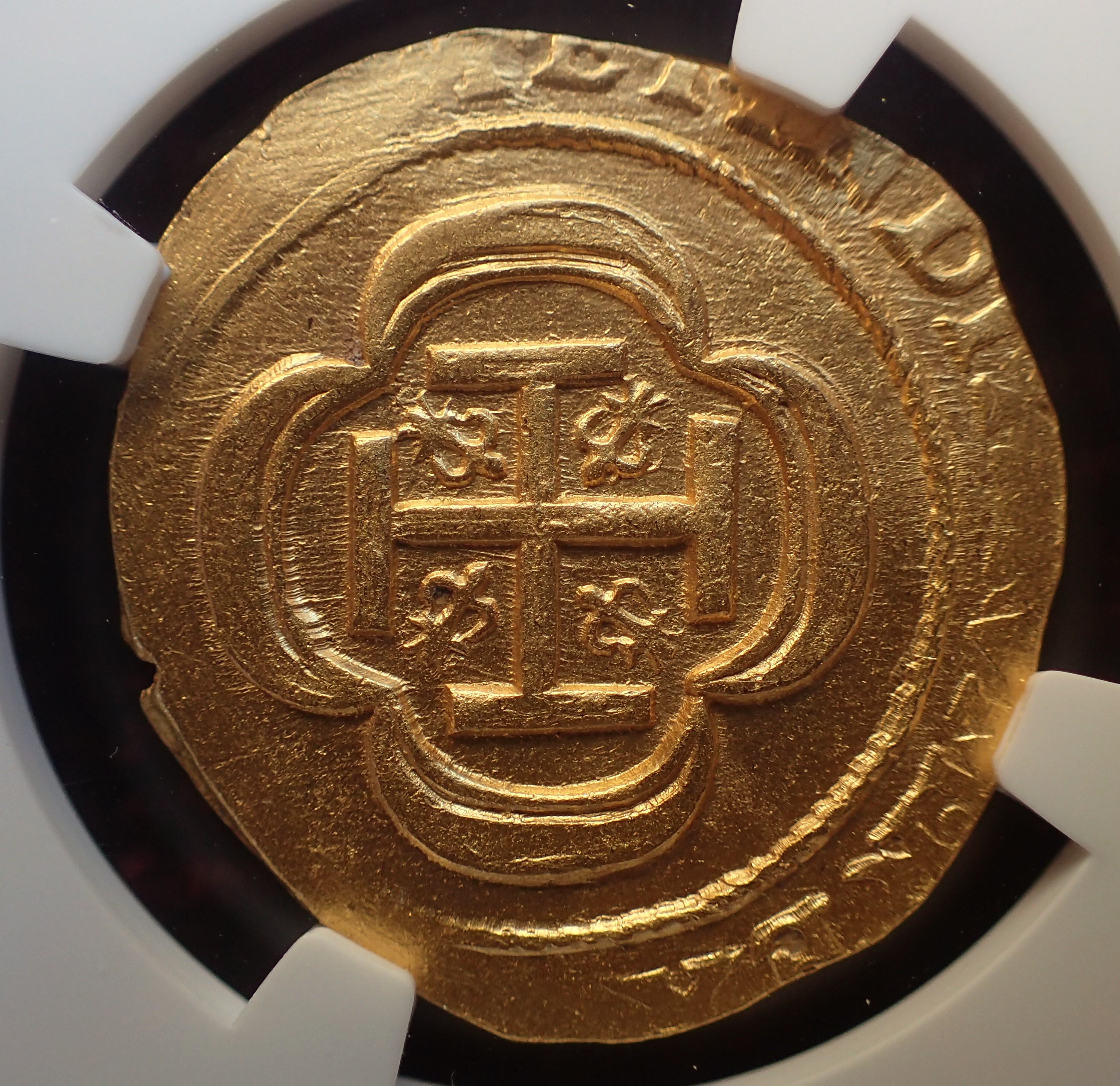
************* M55. Viceroyalty of Nueva Espana, mint of Mexico City, 1714 Mo J four escudos. A very lustrous, boldly struck, choice mint state media onza that looks like it came from the Mexico City mint last week. NGC calls it an MS64 with a 1715 Fleet endorsement. SOLD
The original mintage of 1714 Mexican media onzas is not known exactly, but it was quite small, all from a single pair of dies that shows no progressive wear from use. Before the 1715 Fleet, the 1714 media onza was unknown to numismatists. The summer of 1964 changed that when Real 8 & Mel Fisher found a "Carpet of Gold" on Douglass Beach (supposedly the wrecksite of Adm. Ubiila's patache Nieves.). Several dozen 1714 media onza were part of that treasure. The State of Florida immediately claimed a dozen for its nascent collection.
Choice mint state 1714 media onzas have a distinctive look. You can see the reason for the distinctive luster and color in the picture of the reverse immediately above. Look at all the heavy horizontal polishing marks filling the fields. Probably because rust had begun to form on the smooth surfaces, Mexican die cutters had to vigorously repolish these surfaces. If they had used a finer grain brush, the surfaces would look prooflike. As it is, the surfaces have a look close to modern matte proofs. Notice, by the way, the perfect cross and tressure on this coin. I have never seen another Mexican media onza with complete cross, fleurs and tressures. For the nearest comparable 1714 media onza, see the Pablo Gerber specimen that Spink America sold in December of 1995 (lot 30) for $7200.
SOLD terravitan@aol.com or 480-595-1293
*******************************************************************************************
A Short History of MEXICAN GOLD COBS
The mint at Mexico City issued gold bars and carefully adjusted escudo-equivalent gold ingots from at least 1537--see our Special Page for early Mexican gold ingots-- but was not permitted an official gold coinage until 1679. Thereafter it struck gold cobs annually, but usually in small quantity, until 1732. In that period three Spanish monarchs sat on the throne. The unfortunate Carlos II reigned until 1700, to be succeeded by the first Bourbon monarch Felipe V, whose reign was interrupted for seven moths in 1724 by the accession and death of his son Luis I.
************************************************************************************************
RECENTLY SOLD:
OLD
From the 1715 Plate Fleet
This 1708 onza has the slight reddish tint so often found on 1713 Mexican escudos. It was found in the same area of Colored Beach as the 1713's. I have suggested elsewhere that this reddish tint is typical of gold coins that have spent a long time in contact with saturated organic material. The 1713's and 1708's were probably in a leather pouch when the Nieves sank. This 1708 onza also shows marine deposits and whitish coral, especially on the cross side. It is full weight at 27.0 grams. Besides being one of only two 1708 Mexican onzas--the other 1708 is impounded in a major private collection from which it will not emerge for many years--this is one of less than a dozen dated BOX CROSS onzas known for the entire 1698-1710 type period. By any measure it a major rarity and an amazing survivor from the exiguous early gold coinage of the Mexico City mint.
From the 1715 Plate Fleet
Mexico. Reign of Charles II (1665-1700). Jeweled Cross four escudos, circa 1690. Very Rare.
The first gold issues of the mint at Mexico City featured the distinctive designs you see on this four escudos. The most striking design feature is the ornate jeweled cross. On the 4 escudos, this design continued until 1699, with at least three significant sub-varieties. No one has yet made a study of jeweled cross Mexican escudos, due to the rarity of the type in all denominations, but I am attempting to do so.
This is a middle-style issue, 1688-1694, identified by various distinctive features of the cross, shield and crown. Prior to the salvages from the 1715 Fleet, the entire population of jeweled cross media onzas (1680-1699) was represented by no more than a half dozen or so coins. See the Lopez-Chavez 1961 monograph on the media onza. I believe the 1715 Fleet has added about another half dozen coins to the population, including this exceptional piece.
This jeweled cross 4 escudos has very light sea surfaces and marine deposits/coral, especially in the lower area of the shield. It has good weight at 13.41 gms and a large, rounded planchet. If you would like a jeweled cross Mexican 4 escudos from the 1715 Fleet, this is a chance that may not be repeated for many years.
Sold. ©2007 Goldcobs.com All Rights Reserved. |